


HFIP for Nucleic Acid Analysis
1,1,1,3,3,3-Hexafluoro-2-propanol (HFIP) is frequently used as a mobile phase additive for analysis of oligonucleotides below 100 nucleotides (nt) and their impurities, due to the high sensitivity and separation it enables. However, there are significant differences in LC-MS sensitivity and even detection of unidentified peaks depending on the manufacturer, product grade, and lot. This product is specifically tested using LC-MS for each batch, so researchers can be confident in their reagents.
Features
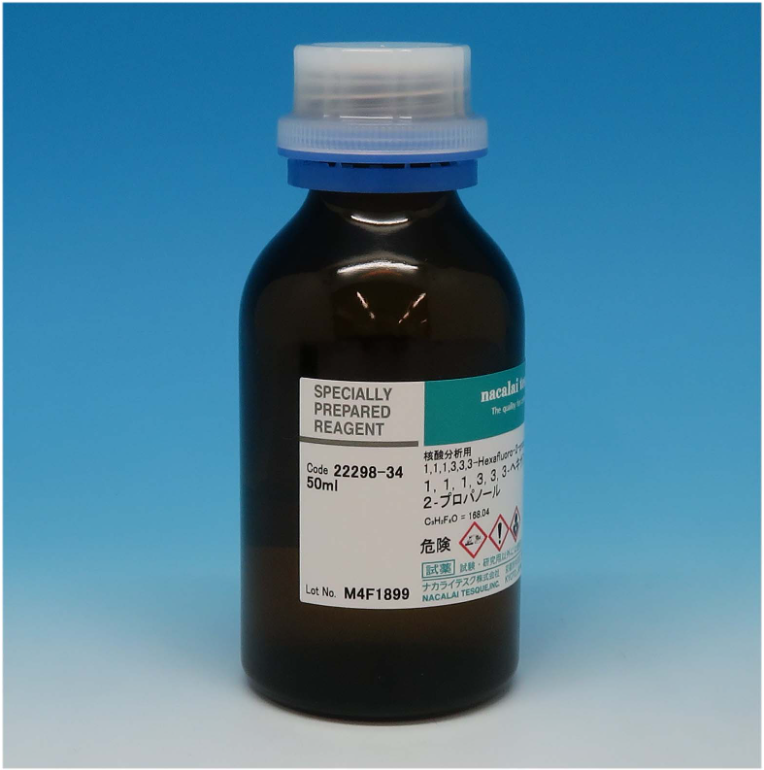
- Suitable for analysis of oligonucleotides using HPLC and LC-MS
- Suitable for analysis of oligonucleotide impurities (short-mers, long-mers, phosphodiester [PO] impurities in phosphorothioated [PS] products)
- Each product lot tested using LC-MS
Performance comparison
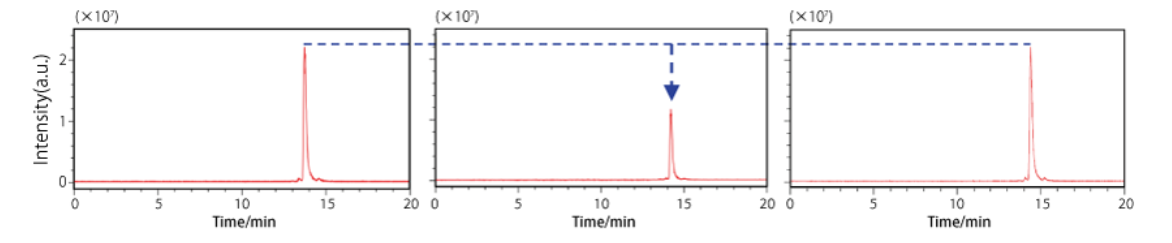
Using the oligonucleotide (Poly(dT)19), LC-MS sensitivity was compared between this product and competitor HPLC and LC-MS grade products.
Nacalai Tesque product
Company A product
(HPLC grade)
Company B product (LC-MS grade)
| LC conditions | |
|---|---|
| Column | COSMOCORE 2.6C18 2.1 mm I.D. × 100 mm |
| Mobile phase | A : 100 mM HFIP-15 mM Triethylamine (TEA) B : Solvent A / Methanol = 1 / 1 (v / v) B conc. 20 → 50%(0 → 20 min) |
| Flow rate | 0.2 mL/min |
| Temperature | 40°C |
| MS conditions | |
|---|---|
| Equipment | LCMS 2050 (Shimadzu) |
| Ionization | ESI/APCI (Negative), TIC |
| Mode | Scan |
| Mass range | 550-2000 |
| Nebulizing gas flow | 2.0 L/min |
| Drying gas flow | 5.0 L/min |
| Heating gas flow | 7.0 L/min |
| DL temperature | 200°C |
| Desolvation temperature | 450°C |
| Interface voltage | -2.0 kV |
Compared to the company A product (HPLC grade), our product showed about twice the sensitivity. Additionally, it had about the same sensitivity as the company B product (LC-MS grade).
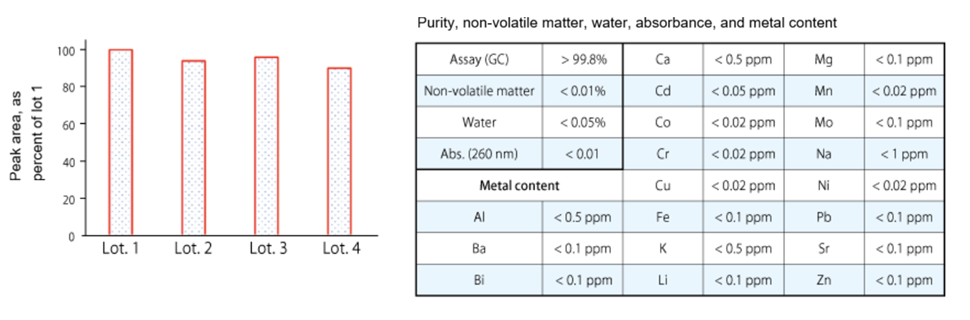
Comparing 4 different lots, the difference in sensitivity was found to be within 10%. Furthermore, there was no significant difference in purity and metal content.
Analysis by LC-MS
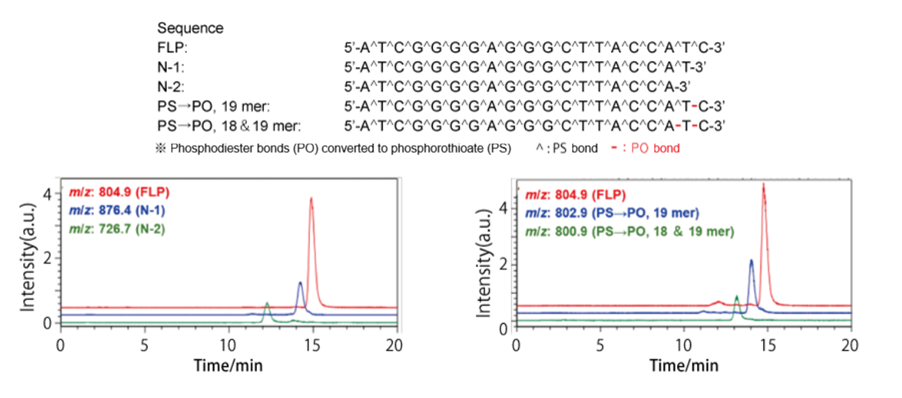
Phosophorothioated oligonucleotides
By optimizing the analysis conditions, we were able to separate the target compound from impurities that are produced during synthesis.
| Conditions | |
|---|---|
| Column | COSMOCORE 2.6C18 2.1 mm I.D. × 100 mm |
| Mobile phase | A : 100 mM HFIP-15 mM Triethylamine (TEA) B : Solvent A / Acetonitrile / Methanol = 2 / 1 / 1 (v / v / v) B conc. 14 → 20%(0 → 20 min) |
| Flow rate | 0.2 mL/min |
| Temperature | 65°C |
| Ionization | ESI/APCI (Negative), SIM |
| Sample conc. | 100 µM (FLP) and 25 µM (others) |
| Inj. Vol. | 1 µL |
DNA ladder
Because hydrophobicity increases with oligonucleotide length, longer strands are retained for longer.
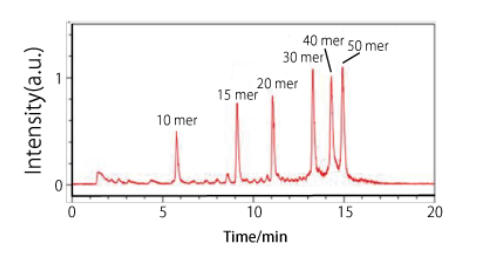
| Conditions | |
|---|---|
| Column | COSMOCORE 2.6C18 2.1 mm I.D. × 100 mm |
| Mobile phase | A : 100 mM HFIP-15 mM Triethylamine (TEA) B : Solvent A / Acetonitrile / Methanol = 2 / 1 / 1 (v / v / v) B conc. 7.5 → 27.5%(0 → 20 min) |
| Flow rate | 0.2 mL/min |
| Temperature | 65°C |
| Ionization | ESI/APCI (Negative), TIC |
| Sample conc. | 10 µM |
| Inj. Vol. | 3 µL |
ssDNA (PO and PS forms), ssRNA
Hydrophobicity increases in the order of RNA < DNA (PO) < DNA (PS), and the strands elute in the same order. Hydrophobicity also changes depending on the DNA sequence, so strands with similar length may have different retention times.
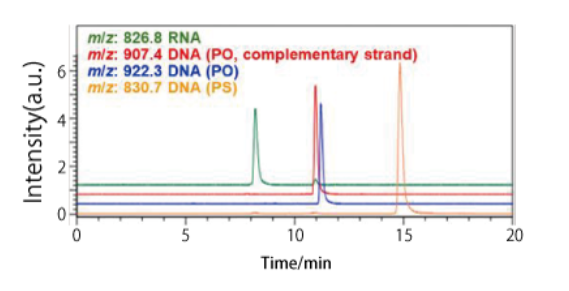
| Conditions | |
|---|---|
| Column | COSMOCORE 2.6C18 2.1 mm I.D. × 100 mm |
| Mobile phase | A : 100 mM HFIP-15 mM Triethylamine (TEA) B : Solvent A / Methanol = 1 / 1 (v / v) B conc. 20 → 60%(0 → 20 min) |
| Flow rate | 0.2 mL/min |
| Temperature | 40°C |
| Ionization | ESI/APCI (Negative), SIM |
| Sample conc. | Sample conc. |
| Inj. Vol. | 3 µL |
References
Separation and purification of short-, medium-, and long-stranded RNAs by RP-HPLC using different mobile phases and C18 columns with various pore sizes
Ozaki M, et al. Anal. Methods. 2024;16:1948-1956.
https://doi.org/10.1039/D4AY00114A
* Featured on Front Cover
Separation of long-stranded RNAs by RP-HPLC using an octadecyl-based column with super-wide pores
Kuwayama T, et al. Anal. Sci. 2023;39:417-425.
https://doi.org/10.1007/s44211-022-00253-w
* Selected as Hot Articles 2023
Ozaki M, et al. Medical Science Digest December Special Issue. 2023, 49, p.40-43.

Cover art on the front cover of Analytical Methods and the award certificate for being selected as one of the Hot Articles 2023.
Downloads
HFIP for Nucleic Acid Analysis (PDF 1.4 MB)
Ordering Information
| Product Name | Grade | Storage | Catalog Number | PKG Size | Price |
|---|---|---|---|---|---|
| 1,1,1,3,3,3-Hexafluoro-2-propanol (HFIP) for nucleic acid analysis | SP | Room temp. | 22941-42 | 25 mL |  |
