


Paper published: Quantitative analysis of D/L-serine and D/L-proline in serum by isotope-coded derivatization using an original chiral resolution labeling reagent
Our paper on a quantitative analytical method for D/L-serine (D/L-Ser) and D/L-proline (D/L-Pro) in serum--developed using our DL-amino acid labeling kit--has been published in the special issue "Chiral Separations for Pharmaceutical and Biomedical Analysis" of Elsevier's Journal of Pharmaceutical and Biomedical Analysis Open. This study is the result of a collaborative research effort with Akari Ikeda of TAIYO NIPPON SANSO Corporation, Takahiro Kawase of the Kyoto Institute of Nutrition and Pathology, Inc., Ai Tsuji of Prefectural University of Hiroshima, Shozo Tomonaga of the Graduate School of Agriculture, Kyoto University, and Prof. Hideaki Kakeya of the Graduate School of Pharmaceutical Sciences, Kyoto University.
Title of the paper: Quantitative analysis of D/L-serine and D/L-proline in serum by isotope-coded derivatization using an original chiral resolution labeling reagent
Authors: Makoto Ozaki1*, Yasunari Yamada1, Tsunehisa Hirose1, Motoshi Shimotsuma1, Akari Ikeda2, Takahiro Kawase3, Ai Tsuji4, Shozo Tomonaga5, Miyuki Matsui6, Takefumi Kuranaga6, Hideaki Kakeya6*
Affiliations:
1 Nacalai Tesque, Inc.
2 TAIYO NIPPON SANSO Corporation, SI Innovation Center
3 Kyoto Institute of Nutrition and Pathology, Inc.
4 Health Sciences Studies, Faculty of Regional Development, Prefectural University of Hiroshima
5 Division of Applied Biosciences, Graduate School of Agriculture, Kyoto University
6 Department of System Chemotherapy and Molecular Sciences, Division of Medicinal Frontier Sciences, Graduate School of Pharmaceutical Sciences, Kyoto University
Journal information:
Journal of Pharmaceutical and Biomedical Analysis Open, Volume 7, June 2026, 100099.
DOI: 10.1016/j.jpbao.2025.100099
Research Summary:
D-Serine (D-Ser), a major co-agonist of the NMDA-type glutamate receptor, plays a critical role in excitatory neurotransmission, synaptic plasticity, learning, and memory. Altered D-Ser levels have been implicated in the pathology of neuropsychiatric disorders such as Alzheimer's disease (AD), schizophrenia, and depression, making D-Ser a promising biomarker candidate to diagnose these disorders. D-Proline (D-Pro) has also attracted attention as a potential biomarker.
In this study, we developed a quantitative method for determining D/L-serine (D/L-Ser) and D/L-proline (D/L-Pro) in serum by isotope-coded derivatization using D-FDLDA and a stable isotope-labeled reagent, 13C6-D-FDLDA (Fig. 1). The derivatized analytes were quantified by single-quadrupole liquid chromatography-mass spectrometry (LC-MS) on a conventional C18 column. The method enabled clear separation of target analytes from interfering components in human serum (Fig. 1), with intra- and inter-day precision values (RSD) below 10% and recovery rates of 90-110%.
A comparison of the %D values of serine and proline (%D = concentration of the D-form / total D+L levels) between healthy subjects and AD patients revealed significantly elevated %D values for both amino acids in the AD group (Fig. 2). These results suggest that the present method may offer a useful analytical platform for future biomarker studies and diagnostic applications related to neuropsychiatric disorders.
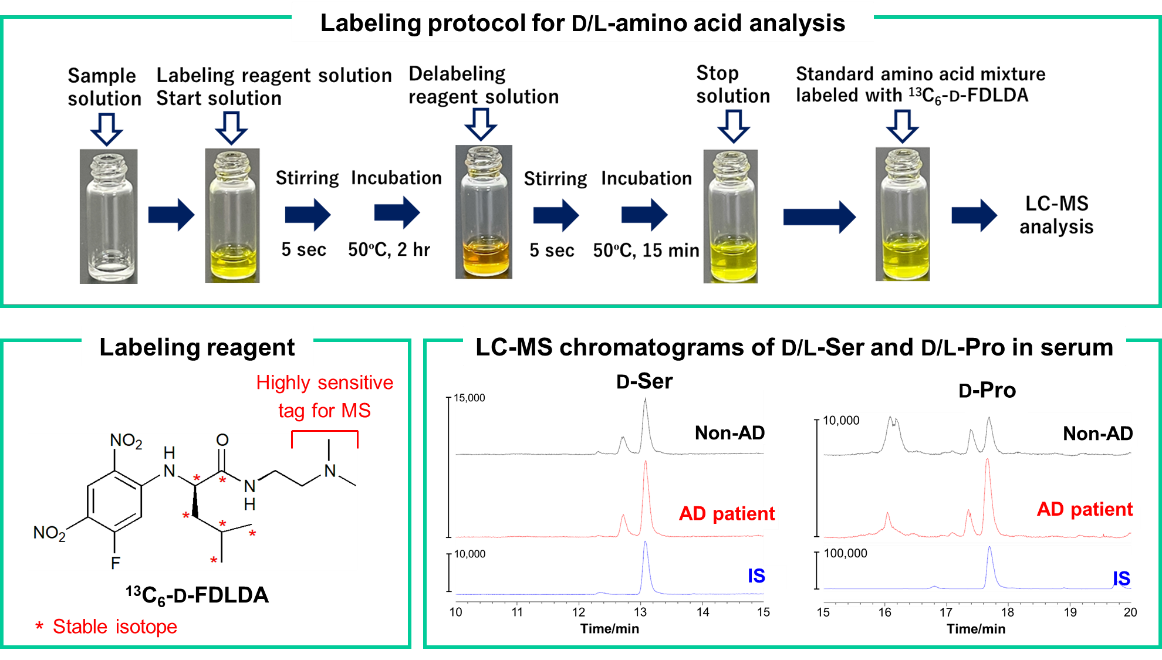
Fig. 1 Overview diagram of this study
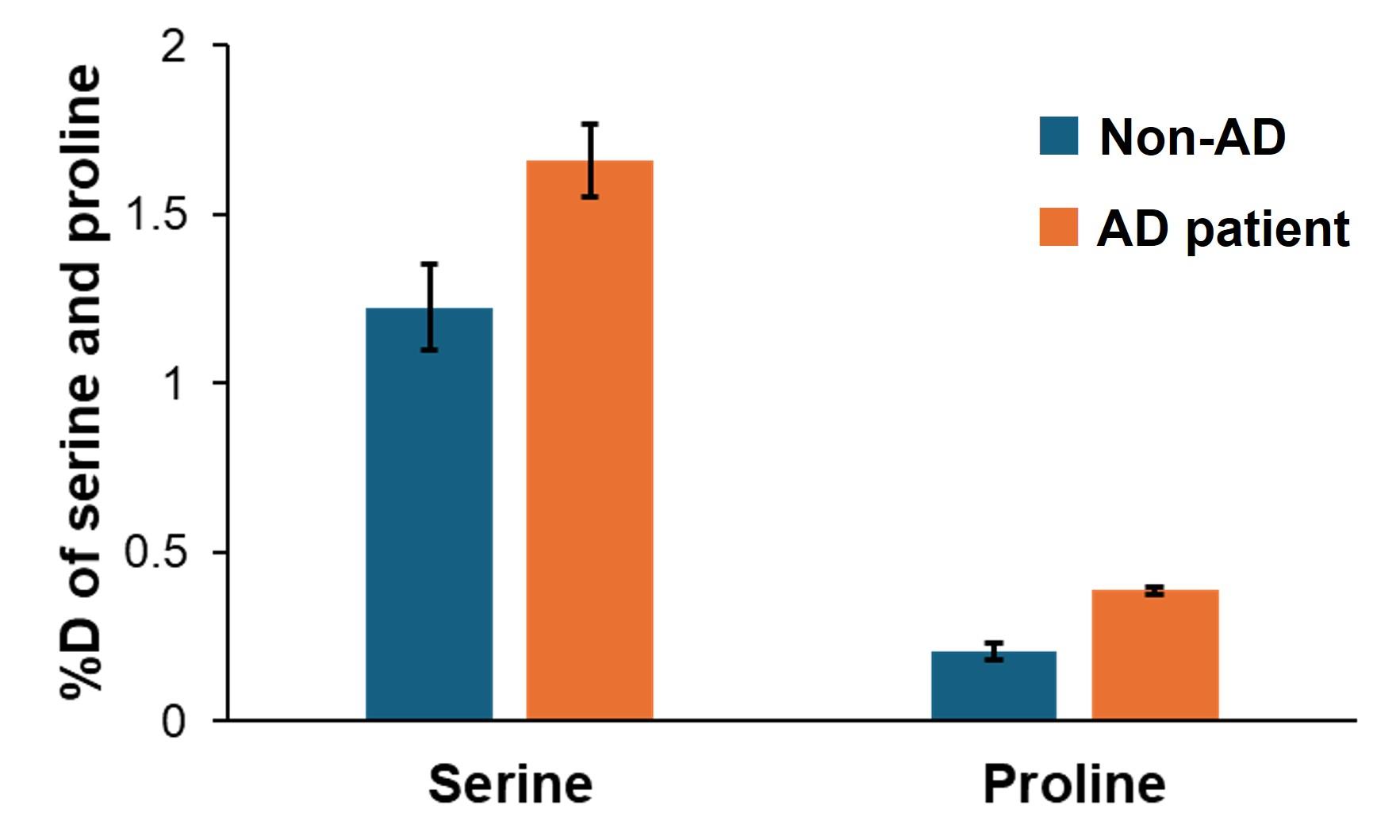
Fig. 2 %D values of Ser and Pro in serum from healthy subjects and AD patients
Products Used in This Study:
DL-Amino Acid Labeling Kit 19942-74 100TESTS NACALAI TESQUE, INC.
COSMOCORE® 2.6C18 Packed Column 2.1mmI.D.x100mm 12614-71 1PKG NACALAI TESQUE, INC.
Related Publications:
M. Ozaki, T. Nakade, M. Shimotsuma, A. Ikeda, T. Kuranaga, H. Kakeya, T. Hirose, Simultaneous analysis of DL-amino acids in foods and beverages using a highly sensitive chiral resolution labeling reagent, J. Chromatogr. B, 1244, 124239 (2024).
https://doi.org/10.1016/j.jchromb.2024.124239
M. Ozaki, M. Shimotsuma, T. Kuranaga, H. Kakeya, T. Hirose, Identification of racemised and isomerised aspartic acid residues in amyloid β peptides using an original chiral resolution labeling reagent, Analyst, 148, 1209-1213 (2023).
https://doi.org/10.1039/D2AN01885C
※ Selected as Analyst HOT Articles 2023 and featured on Front Cover
https://doi.org/10.1007/s00216-022-04048-w
